


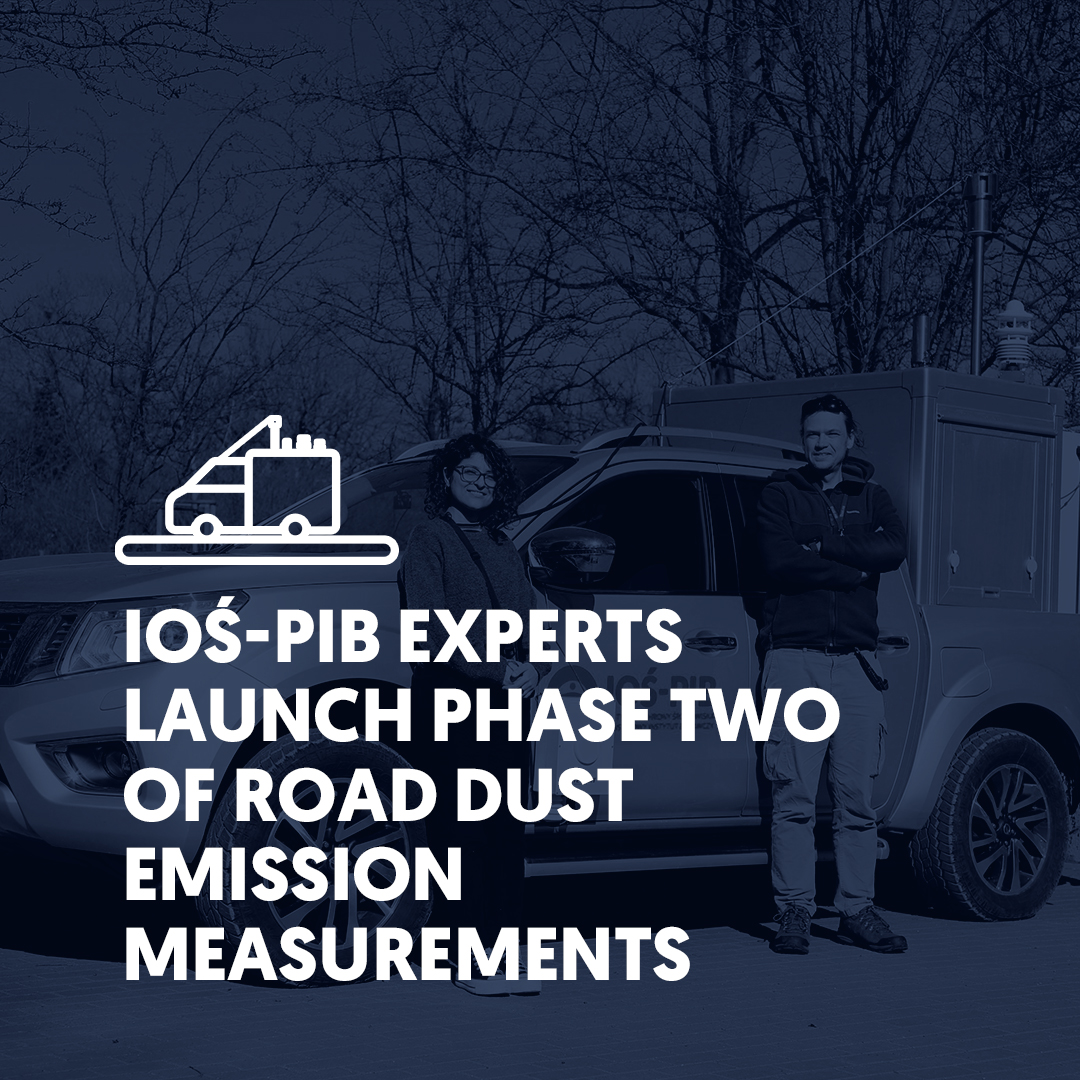
The second, spring-summer phase is now underway for the project entitled “Measurement of Road Dust Emissions – Direct Sampling Technique”, carried out in Warsaw by the KOBiZE at IOŚ-PIB road surface dust resuspension. Under the supervision of Dr Anahita Sattari, experts are developing methodologies based on field measurements to enable the quantitative assessment of non-combustion particulate matter emissions. The measurements cover emissions from non-exhaust sources: brakes, tyres, and above all, road surface dust resuspension.
The first phase of the study, conducted from October 2025 to February 2026, comprised five measurement campaigns carried out under urban winter conditions. A unique mobile laboratory was equipped with PM10 sensors positioned close to the vehicle wheels, as well as a reference instrument mounted on the roof (at 3.2 m), enabling the recording of short-term and dynamic PM10 concentration spikes occurring exclusively as a result of road dust resuspension. Analysis of the collected data allowed for the identification of actual dust resuspension episodes and a preliminary estimation of PM10 emission factors.
– “Exhaust emissions from passenger vehicles have declined thanks to Euro 6 standards and the widespread use of particulate filters, while road dust resuspension – accounting for 30–70% of PM10 in urban areas – remains unregulated. As exhaust quality improves, the proportional contribution of non-exhaust sources increases,” explains project leader Dr Anahita Sattari.
PM10 particles can remain suspended in the atmosphere for up to several hours, and under favourable conditions – such as low precipitation and weak wind – for up to one day. Gravitational settling of PM10 is faster than that of PM2.5, which may remain airborne for several days.
People with respiratory diseases are particularly vulnerable to emissions from road dust resuspension. “PM10 deposits in the bronchial and upper respiratory tract, causing inflammation, irritation, and reduced lung function. Both short-term and long-term exposure exacerbates asthma and chronic obstructive pulmonary disease (COPD), and increases the risk of infections and hospitalisation,” adds Dr Anahita Sattari.
The final results will be used to determine emission factors applied in the methodologies for calculating transport emissions in the Central Emissions Base (CEB).
The project is being implemented as part of a task funded by a subsidy from the Ministry of Science and Higher Education (MNiSW).