


Instead of treating waste solely as a problem, it is worth viewing it as a precious asset. A plastic bottle, a milk carton, or a glass jar is, from the perspective of both the economy and environmental protection, a valuable material that can be reused. Global Recycling Day is an excellent opportunity to remind ourselves that our rubbish should not end up in landfills, but should instead re-enter circulation as raw material for the production of new goods.
Experts at the Institute of Environmental Protection – National Research Institute (IOŚ-PIB) emphasise that much of what we discard today without a second thought holds considerable value. “The use of glass and metals brings enormous environmental benefits, particularly within multiple-use cycles. Metals, primarily aluminium, can be processed repeatedly with very little loss of quality. Paper and cardboard, meanwhile, perform excellently as packaging for dry products; however, it is crucial to avoid additional coatings – such as foil or surface finishing treatments – which later make recycling significantly more difficult,” explains Tomasz Kaczmarek, M.Sc., Head of the Waste Management Department at IOŚ-PIB.
In accordance with the waste management hierarchy, the priority is to reduce the use of single-use packaging and to develop systems for its reuse. Positive changes are already visible in retail and the food service industry, where deposit-return packaging systems are in use and customers may bring their own containers for purchases. Such solutions tangibly reduce the volume of waste and support a circular economy. It should also be borne in mind that “biodegradable” materials do not solve the waste problem if there is no efficient system of separate bio-waste collection and access to appropriate composting facilities in place.
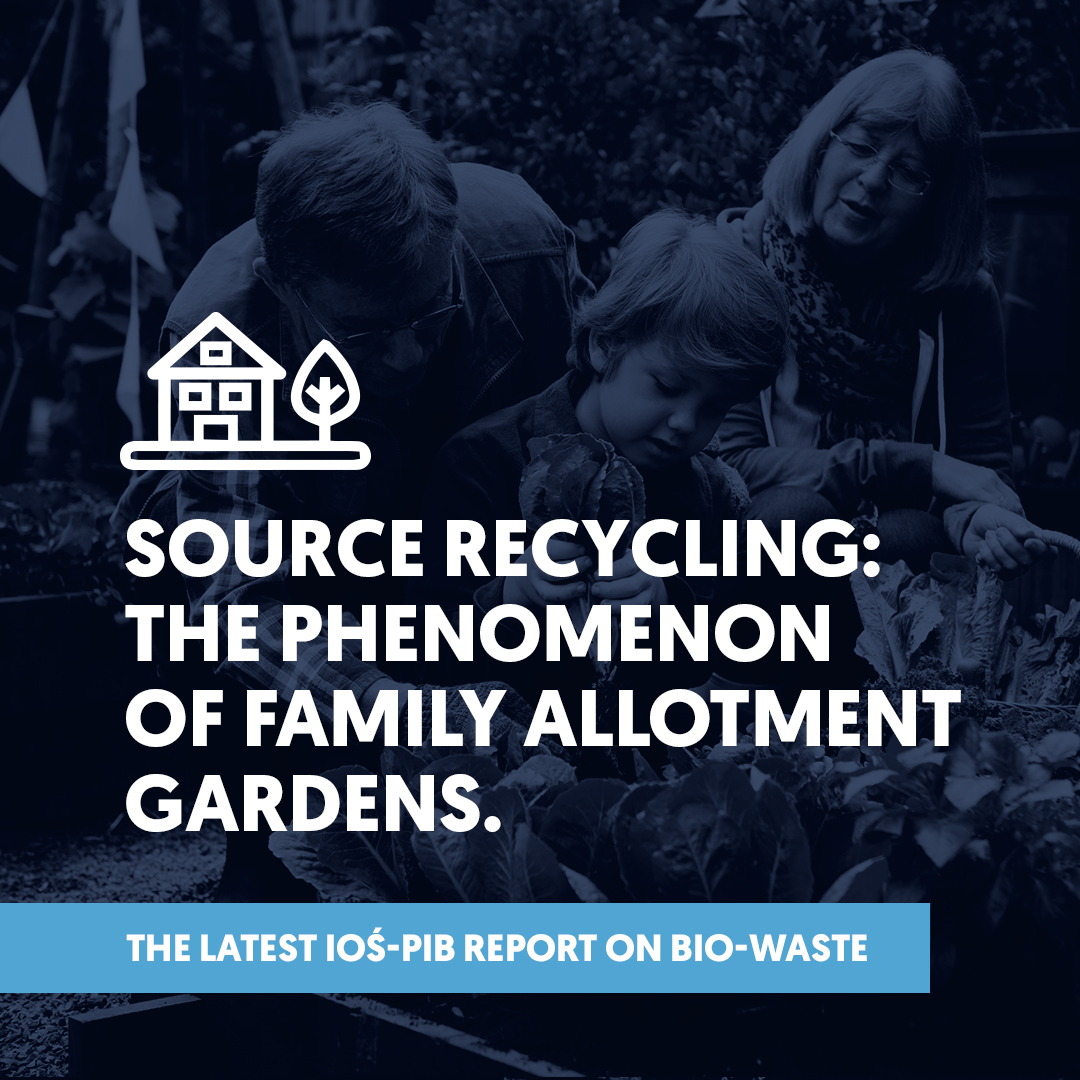
According to the latest IOŚ-PIB report on bio-waste, Family Allotment Gardens (Rodzinne Ogrody Działkowe – ROD) represent an excellent example of a sustainable approach to organic waste matter. It is here that the proximity principle and the most straightforward form of recycling are put into practice.
Why is bio-waste management on allotment plots a model solution?
Source recycling (no transport costs): the vast majority of bio-waste – such as mown grass and leaves – is not collected by refuse lorries; it is managed precisely where it is generated, entirely eliminating transport costs and the associated exhaust emissions.
Simple and natural technology: allotment gardeners require no complex industrial facilities. They employ composting – a controlled, natural decomposition process – and an exceptionally simple and inexpensive method of producing a fully effective fertiliser.
Significant scale of operation: calculations by IOŚ-PIB show that the average quantity of bio-waste composted in this way across Polish ROD amounts to as much as 1.49 kg/m² during the growing season.
Relief for the municipal waste system: taking into account the total area of allotment gardens in Poland, it is estimated that over 558,700 tonnes (Mg) of bio-waste are composted within them annually – a staggering quantity that never reaches municipal bins, thereby assisting local authorities in meeting the legally required bio-waste recycling targets.
Although the waste management system is built by local authorities and businesses, its ultimate effectiveness depends on the everyday decisions of each and every one of us. Proper sorting, composting in domestic gardens, and reusing products are simple steps that, at a national scale, bring genuine relief to the environment. Family Allotment Gardens demonstrate that the best and most affordable solutions are often right at our fingertips.